

Best AI visibility tools for ecommerce in 2026
The best AI visibility tools for ecommerce help retailers understand whether AI assistants recommend products they sell, which store gets the purchase link and what traffic and sales follow. AI visibility tools monitor how a brand, store or product appears in AI-generated answers and shopping recommendations. For retailers, compare product matching, merchant attribution, market coverage, practical actions and commercial reporting, not just how often a name appears.
By Molly Sishton. Updated .
In short
- Profound suits broad answer and citation research, with Enterprise shopping analysis.
- Peec AI combines product and merchant analytics with source intelligence.
- Otterly.AI offers a focused starting point for brand and citation monitoring.
- Sighted combines product-by-product visibility analysis, catalogue-gap identification, enrichment, feed optimisation, publishing and measurement of subsequent visibility, traffic and sales.
Best AI visibility tools for ecommerce at a glance
Use this shortlist to match the tool to your team's main task. A manufacturer tracking its stockists needs different reporting from a retailer trying to win the purchase link.
| Tool | Best suited to | Key buying consideration |
|---|---|---|
| Profound | Answer, citation and competitor research; Enterprise shopping analysis | Shopping access, merchant reporting, countries and evidence exports on your quoted plan |
| Peec AI | Brand monitoring, SKU-level shopping analytics and merchant reporting | Exact-product matching, shopping entitlements and retailer attribution with your catalogue |
| Otterly.AI | Starting a focused programme of brand, citation and prompt monitoring | Prompt coverage, citation reporting and the categories your team wants to monitor |
| Sighted | Product-level analysis, catalogue enrichment, feed optimisation, publishing, and visibility, traffic and sales measurement | How the analysis, publishing and performance reporting fit your store and catalogue |
What building SO-ME taught us about product discovery
We came to this problem while building a shopping product ourselves.
My sister Connie and I co-founded SO-ME, a consumer shopping platform bringing together products from retailers including ASOS, Marks & Spencer and REVOLVE.
Working with retailer catalogues exposed a recurring problem: shoppers describe occasions, preferences and constraints, while product records use inconsistent categories and leave out useful attributes. Matching the two requires more than recognising the retailer's name.
For a winter-wedding dress, size, budget, length, fabric and delivery can all affect the buying decision. A product can fit the brief but be difficult to match when those details are missing from its information.
We built Sighted to address that gap: analyse visibility product by product, improve the catalogue and feeds, publish the changes, and measure subsequent visibility, traffic and sales. That operating experience shapes this comparison's focus on product discovery and purchase opportunities.
What should an ecommerce AI visibility tool measure?
Compare five signals: brand mentions, specific product recommendations, merchant links, shopping-card appearances, and resulting visits and purchases. The table below shows how each connects to the buying journey.
Follow the opportunity from the shopper's question through to the purchase.
| Signal | What it establishes | The next commercial question |
|---|---|---|
| Brand or store mention | Your name appears in the sampled answer | Was the shopper looking to buy, and was the mention positive or relevant? |
| Product recommendation | An identifiable product is suggested | Is it a product you sell, and does it meet the request? |
| Retailer or product-page link | The answer provides a route to a merchant | Does that route lead to your store or another stockist? |
| Shopping-card appearance | A product appears in the shopping surface captured | Which variant, price and merchant are displayed? |
| Referral and transaction | A visit or purchase is observed in your analytics | What revenue, margin and customer value followed? |
What if an assistant recommends a product you stock but links elsewhere?
A product recommendation can benefit a manufacturer while sending the retailer's potential customer to another stockist.
For example, an answer to “Where can I buy Nike Air Force 1 trainers in the UK?” might recommend the shoe, mention ASOS and link elsewhere. Track the product, named retailer and destination URL separately to see who receives the opportunity.
Which shopping prompts should you track?
Track questions customers ask before buying: product discovery, comparisons, suitability, availability and delivery. Use customer enquiries, on-site searches and search-query data to choose them.
Include both named-product and unbranded needs. “Where can I buy Nike Air Force 1 trainers?” tests merchant discovery; “white leather trainers under £80” tests whether a product enters consideration before the shopper chooses a brand. A tracked prompt set helps investigate these journeys; it is not a count of customer demand.
What the ASOS tool evaluation revealed
The ASOS evaluation highlights three buying checks: whether the setup matches your market, whether you can inspect actual recommendations, and whether source analysis points to useful actions.
1. A dashboard can answer the wrong market's question
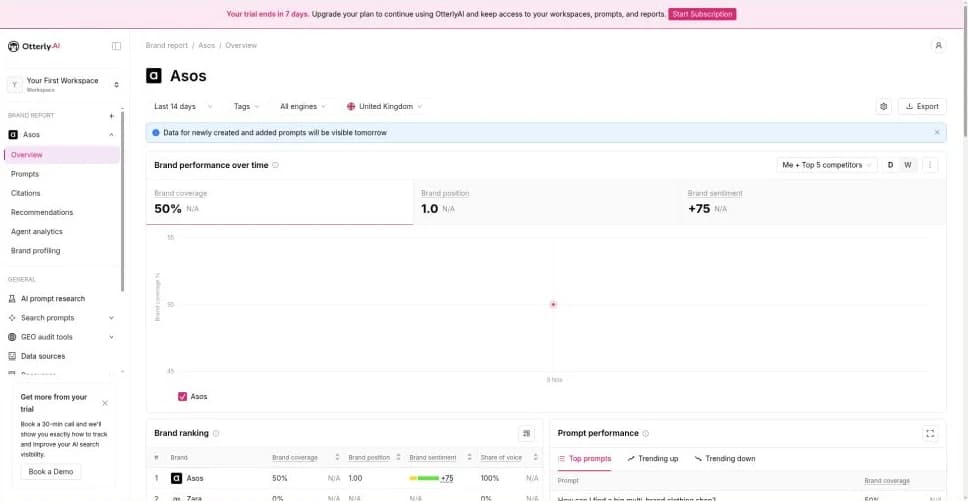
The report recorded Profound defaulting to a US setup and a competitor list including Nordstrom, Old Navy and Quince. Otterly detected the UK and selected competitors including Next, New Look and River Island.
Check the country, language, competitors and delivery assumptions before building a UK retail strategy from the first report.
2. Look behind the score at the actual recommendation
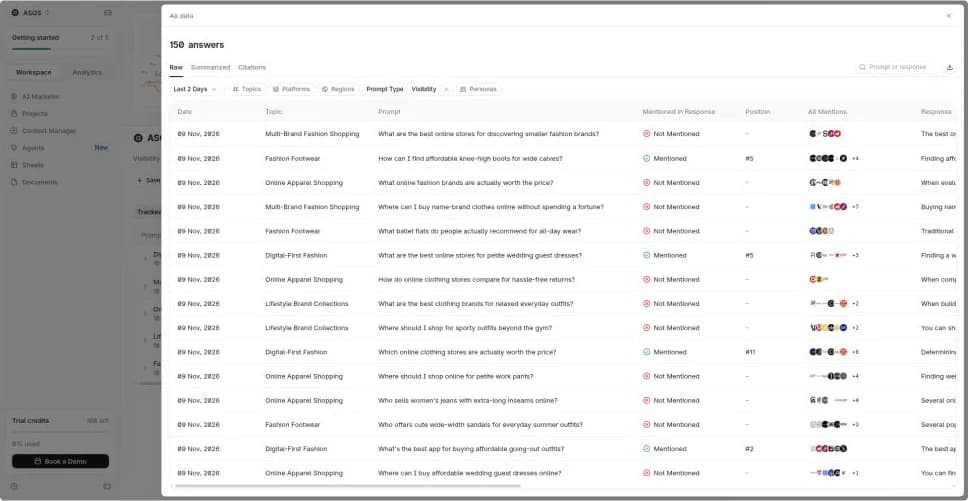
The Profound trial exposed underlying responses and citation information in the ASOS evaluation. That lets a retailer investigate whether a “win” was a meaningful recommendation, a passing mention or a link to the wrong destination.
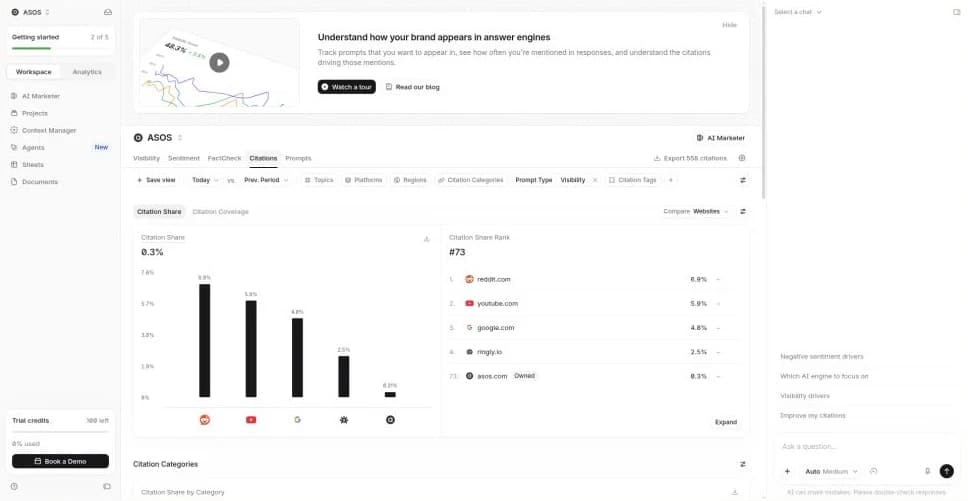
Citation reports identify the pages informing an answer. Inspect the retailer links as well to establish where a shopper is being sent.
3. Understand which sources influence purchase recommendations
Peec's source and Gap Analysis views help identify pages and publishers featuring competitors. This gives a retailer specific content and outreach opportunities.
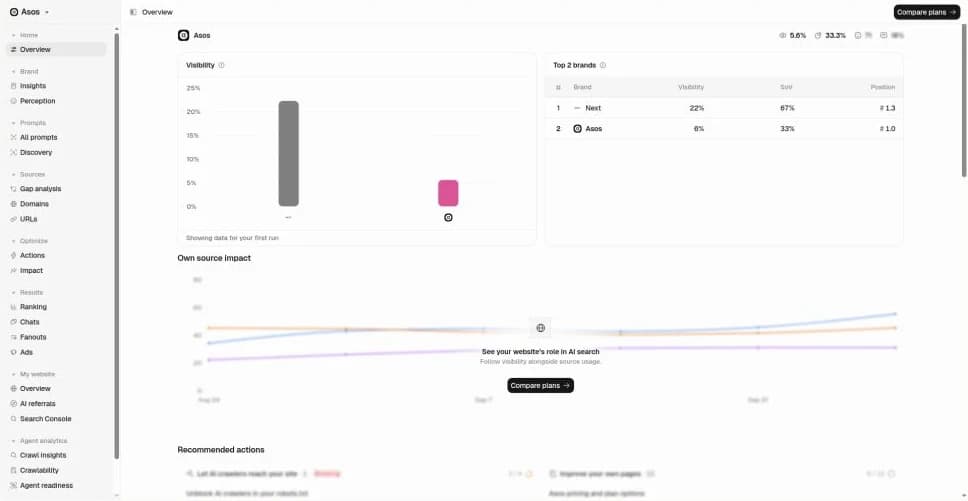
An occasionwear retailer could use that detail to find buying guides cited for winter-wedding questions, check the products featured and prioritise its own category and product pages.
Profound vs Peec AI vs Otterly.AI vs Sighted
Profound for answer research and Enterprise shopping analysis
Profound brings answer, citation and competitor research together. Its trial includes 50 daily prompts across ChatGPT, Gemini and Google AI Overviews for seven days. Enterprise adds ChatGPT Shopping and custom coverage. A retailer assessing its shopping capabilities should focus on product identity, merchant attribution and access to the underlying answers.
Best suited to: teams investigating broad AI visibility and shopping performance with an enterprise research platform.
Peec AI for product tracking and source intelligence
Peec AI combines brand monitoring, SKU-level shopping analytics and source intelligence. Retailers can investigate which products appear, which merchants are recommended and where competitors have stronger visibility.
Merchant reporting matters when several stores sell the same product: the product can be recommended while another stockist receives the link.
Prompt-level reporting and buying-intent filters help teams focus on shoppers comparing options or choosing where to buy. Source analysis and Gap Analysis identify relevant pages and publishers, while prioritised actions support content and outreach planning.
Retailer use case: monitor a valuable category, inspect recommendations where competitors appear, and assign improvements to content, merchandising or acquisition teams. Review traffic and conversions alongside visibility.
Best suited to: teams wanting product and merchant tracking, competitor comparisons and source-led action planning.
Otterly.AI for focused brand and citation monitoring
Otterly.AI tracks brand visibility, sentiment and citation sources. Its Lite plan includes 15 prompts with daily monitoring across four included engines at $29 per month; additional engines are available as add-ons.
Start with one valuable range and questions covering discovery, comparison and purchase intent. Inspect the answers and cited URLs to decide which pages or topics need attention.
Best suited to: smaller teams starting a focused brand-and-citation monitoring programme.
Sighted for product analysis, optimisation and performance
Sighted analyses visibility product by product, identifies catalogue gaps, enriches product information, optimises feeds for AI agents and Google Shopping, publishes to Shopify and supported channels, and measures subsequent visibility, traffic and sales.
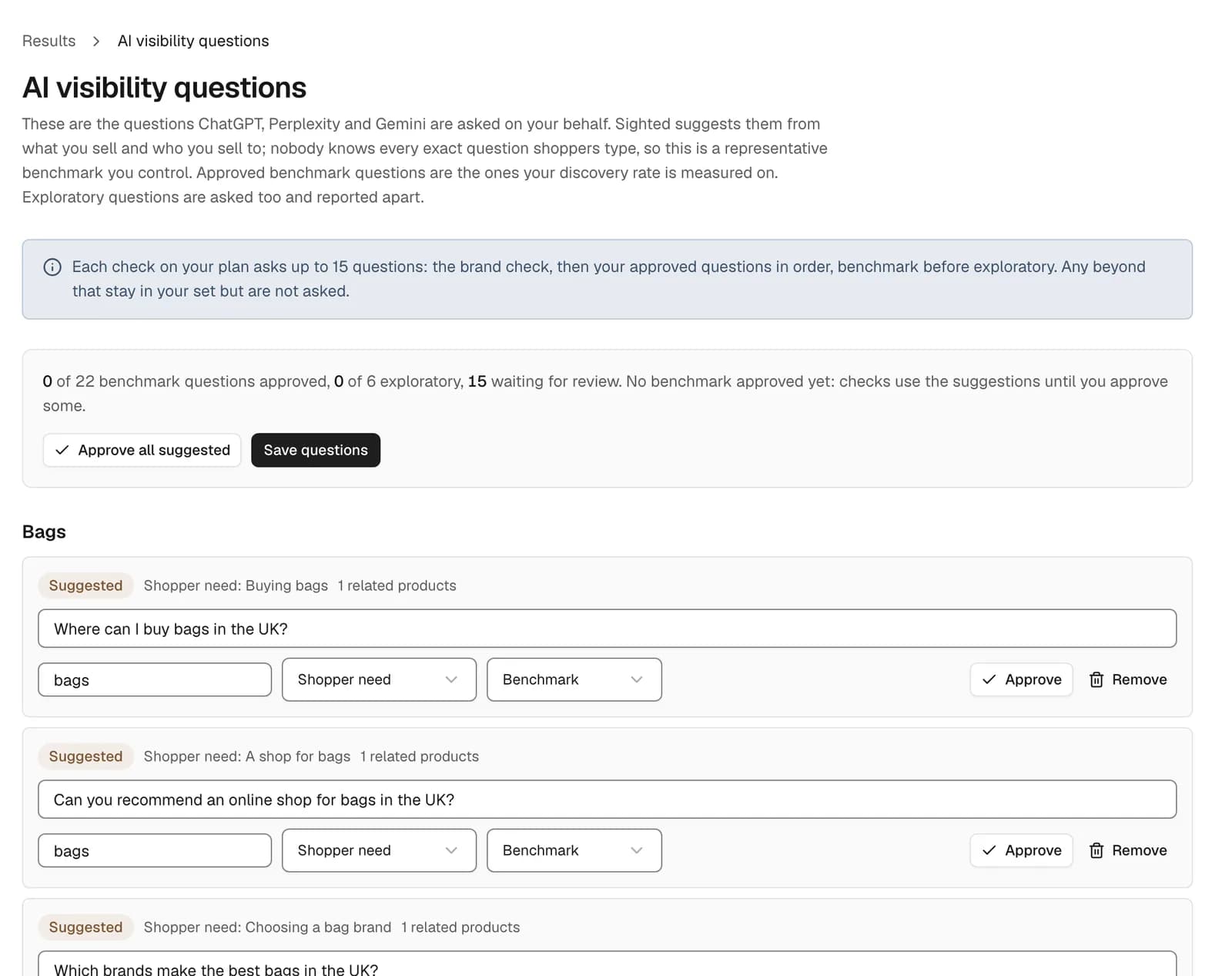
Product-level visibility analysis checks whether assistants identify and recommend each product, name the store and link to the relevant page. Use named-product and needs-based questions to assess both merchant selection and discovery.
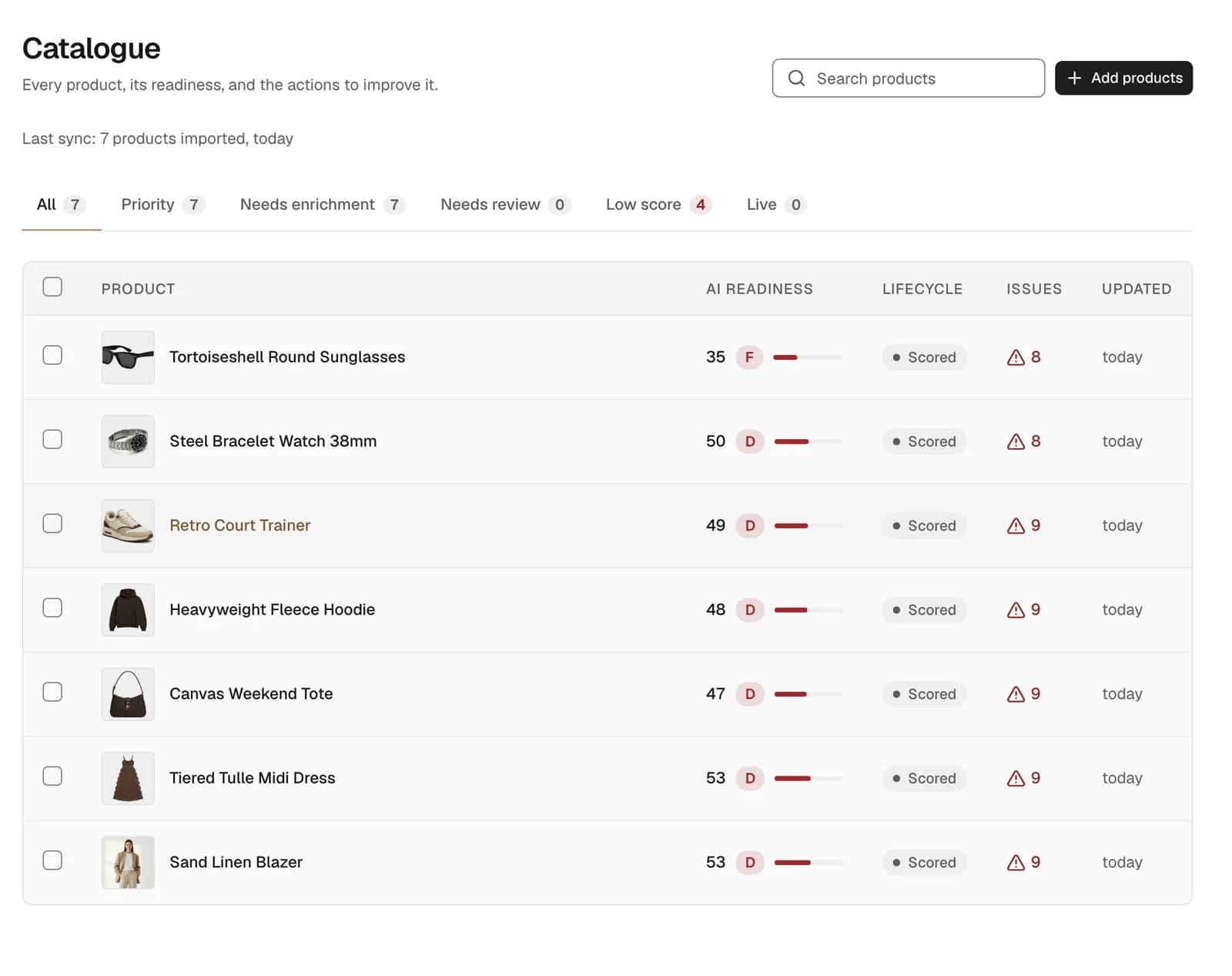
Catalogue analysis identifies missing attributes and information. Prioritise gaps affecting important buying requirements: fabric and fit for clothing, compatibility for electronics, or specifications and use cases in other categories.
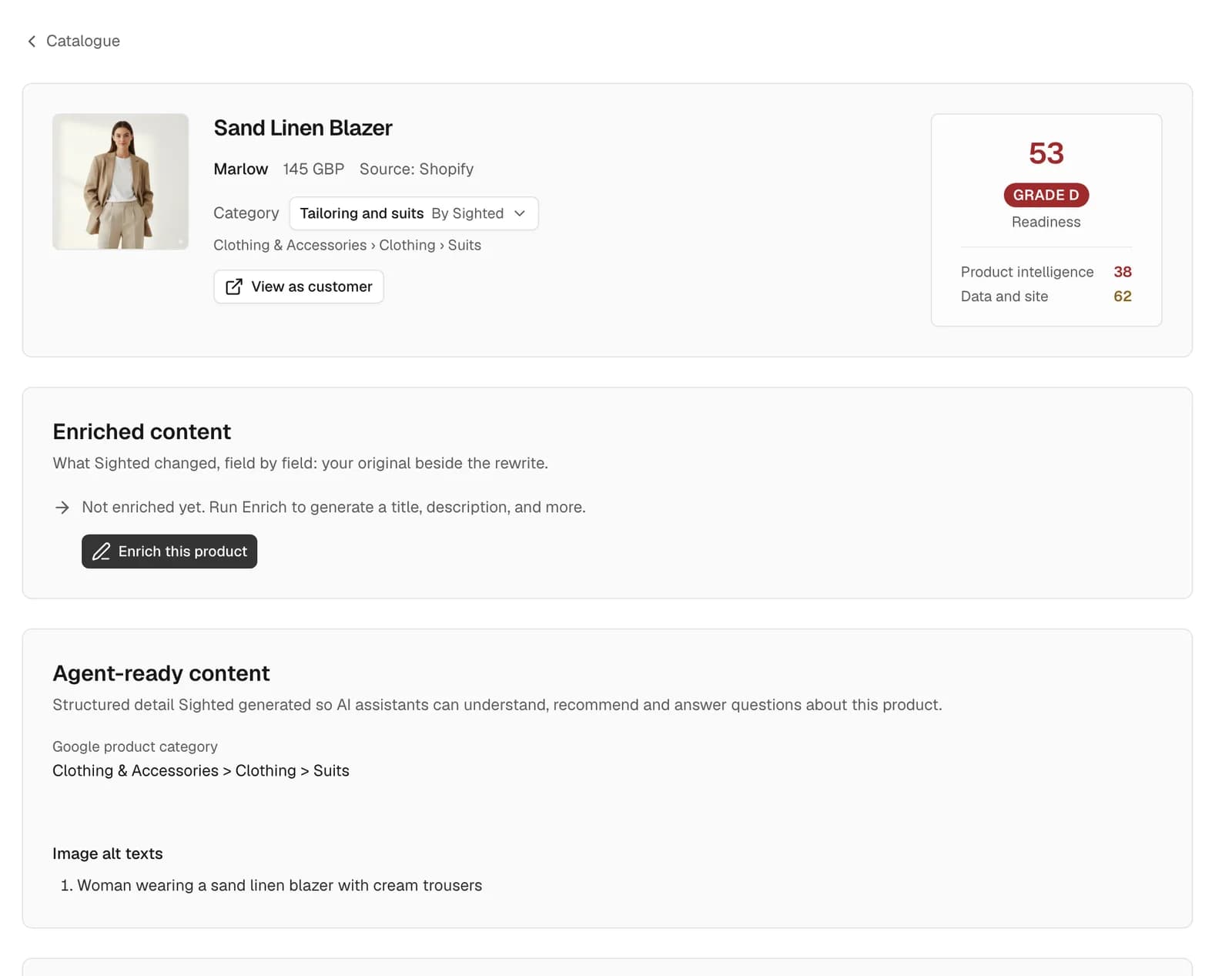
Enrichment improves relevant attributes, titles, descriptions and FAQs using the retailer's product information.
Feed optimisation and publishing carry approved information into Shopify, Google Shopping and AI-agent feeds through the supported channel workflow.
Performance reporting follows subsequent visibility, traffic and sales, connecting the product changes with discovery, store visits and purchases.
Best suited to: retailers wanting product-level analysis, catalogue and feed improvements, publishing and commercial performance measurement in one workflow.
How do you connect AI visibility with customers and sales?
Measure recommendation visibility alongside referral traffic and transactions. Review performance by product and category so the team can connect discovery work with customer behaviour and sales.
Measure where AI-referred visitors land and what they buy
Group identified AI-assistant referrals in analytics and review landing pages, sessions, product views, orders, revenue and conversion rate. Include average order value, margin and new-customer measures where available.
The Bean Coffee Company: +31% pilot-product revenue
Sighted improved product information, collection pages and buying guides for The Bean Coffee Company, helping customers discover its products through AI and search.
The work delivered incremental product sales through improved AI and search visibility. It illustrates why catalogue improvements should be assessed against commercial results as well as recommendation metrics.
What should you do when a product is missing from recommendations?
Compare the information available for recommended products with your own. If a competing boot clearly states “wide fit” and your suitable product leaves that detail out, verify the attribute and fill the gap. Repeat for the shopper's other requirements.
Publish the supported changes and review visibility, traffic and sales over time alongside price, stock and promotions.
How to evaluate a tool before committing
Run a small buying test around a commercially important range. It should expose the evidence you will actually use, rather than merely populate a dashboard.
- Select ten exact products. Include an own-brand item, a third-party product, similar models and variants. Save identifiers, URLs, current prices and stock.
- Choose 15 to 20 realistic buying questions. Label their origin and separate discovery, comparison, availability and named-product intent.
- Align the setup. Use equivalent countries, languages, engines and dates where supported. Record any restrictions preventing a fair comparison.
- Inspect individual answers. Check suitability, product identity, merchant, destination URL and whether price or stock information is supported.
- Assess the action. Can someone on your team turn the finding into a specific investigation or change? Who owns that work?
- Check the commercial connection. Establish how referral and purchase reporting will be accessed, and make visibility, traffic and sales part of the same performance review.
- Price the workflow. Include required add-ons, regions, prompt capacity, exports and the people needed to implement changes.
AI visibility tools for ecommerce FAQs
Will a high AI visibility score mean more sales?
Focus on visibility for questions with buying intent. Check whether the recommended products suit the request, whether the purchase link leads to your store, and how those visitors convert. These measures show where visibility is creating a commercial opportunity and where your team should improve the journey.
Which AI visibility tool should a Shopify store choose?
Choose around the job: monitoring products and merchant links, improving catalogue information, or completing both. Check whether the Shopify connection reads the catalogue, publishes approved changes, or does both. Sighted supports product-level analysis, enrichment, feed optimisation, publishing and subsequent visibility, traffic and sales measurement.
How is product tracking different from brand monitoring?
Brand monitoring measures whether the business is named and how it is described. Product tracking identifies specific items and recommendations. Multi-brand retailers also need merchant attribution to see which stockist receives the purchase link.
How much do AI visibility tools for ecommerce cost?
Entry costs in this comparison include Otterly.AI Lite at $29 per month and Peec AI Starter at $95 per month. Profound Enterprise uses custom pricing. Compare the plan covering your required prompts, markets, shopping reports and integrations, plus the work needed to act on findings.
How to choose your ecommerce AI visibility tool
Start with a commercially important product range. Confirm that the tool identifies the right products, shows which retailer gets the link, and gives your team useful actions. Then track visibility, traffic and sales as the work is implemented.
Run Sighted's free catalogue scan to identify access and product-information gaps across supported product pages.
Sources and author
Published hands-on reviews: AEOToolsHub's paid-account Peec review and SaaSInsight's live-account Peec analysis. Review findings are attributed to those authors.
Vendor information: Profound, Peec AI and Otterly documentation, checked 9 November 2026. Product features and plan details can change. Peec's shopping documentation describes its product and merchant analytics.
Operating experience: building SO-ME and working with retailer catalogues through Sighted. The Sighted images are existing platform screenshots using sample-store data. Competitor screenshots are from the ASOS evaluation.
Client results: The Bean Coffee Company case study, October 2026. Pilot-product revenue increased 31%, with incremental sales from improved AI and search visibility.
About the author: Molly Sishton is co-founder of SO-ME and Sighted and has more than ten years' experience in SEO. Her work brings together consumer shopping behaviour, retailer product data, AI discovery and commercial performance.
Find the access and product-information gaps on your product pages.