

Profound alternatives for ecommerce
A Profound alternative for ecommerce should show whether AI assistants recommend products you sell, whether your store gets the purchase link and what to change, in your own market. Profound is a strong platform for answer and citation research. This guide compares three alternatives, Sighted among them, using a hands-on evaluation run on asos.com on 9 November 2026.
By Molly Sishton. Updated .
In short
- Profound suits answer and citation research: in the ASOS evaluation every score opened the full answer, while shopping analysis sat on its sales-led Enterprise plan.
- Peec AI suits teams that want product-level tracking from an uploaded catalogue, with source analysis, at a published monthly price.
- Otterly.AI suits a small team starting brand and citation monitoring: its trial detected the UK and chose UK competitors for ASOS.
- Sighted covers the whole job: product-by-product visibility analysis, catalogue gaps, enrichment, feeds for AI agents and Google Shopping, publishing to Shopify, and measuring the visibility, traffic and sales that follow.
Profound alternatives for ecommerce at a glance
Match the tool to the question your team has to answer next. A footwear retailer that stocks Dr Martens 1460 boots needs to know which stockist an answer links, and a brand score does not show that.
| Tool | Best suited to | Key buying consideration |
|---|---|---|
| Profound | Answer, citation and competitor research, with every score traceable to its answer | Shopping analysis and extra regions are on Enterprise, bought through its sales team |
| Peec AI | Product-level tracking from an uploaded catalogue, with competitor and source analysis | The free preview kept full answers behind the paywall, and the trial takes a card |
| Otterly.AI | Starting brand, sentiment and citation monitoring in your own market | Brand-level reporting: the evaluation found no product or shopping tracking |
| Sighted | Product-by-product visibility analysis, catalogue enrichment, feed optimisation, publishing, and visibility, traffic and sales measurement | How your store connects: directly on Shopify, by product file (CSV) elsewhere |
The experience behind this comparison
Molly and Connie Sishton are sisters. They co-founded SO-ME, a consumer shopping platform bringing together products from retailers including ASOS, Marks & Spencer and REVOLVE.
Working with retailer catalogues showed them a recurring problem. Shoppers describe occasions, preferences and constraints. Product records use inconsistent categories and leave out useful attributes.
They built Sighted to address that gap. It is why this comparison asks whether each tool reports on the product a shopper would buy as well as the brand.
What should you check before choosing a Profound alternative?
Six checks tell you whether a tool will answer a retailer's question. Each can be run on your own products during a trial.
| What to check | Why it matters to a retailer | How to test it in a trial |
|---|---|---|
| Your market | The country setting decides which shoppers' answers and which competitors you see | Read the country, language and competitor list the setup chose before you read a score |
| The answer behind a score | A mention can be a recommendation, a passing reference or a warning | Open ten answers and read them in full |
| Products as well as the brand | Shoppers buy a product, and a brand score does not say which one was suggested | Ask about three named products you stock and three needs they meet |
| The purchase link | When several stockists sell the same product, another store can get the link | Note where every link in those answers leads |
| What to change | A finding is worth paying for when someone on your team can act on it | Have the vendor show the step after a finding, on one of your products |
| Plan and price | The report you need may sit on a higher plan than the trial | Ask which plan includes it, at what price and on what trial terms |
What if the product is recommended and another stockist gets the link?
Take “Where can I buy Dr Martens 1460 boots in the UK?”. An answer can recommend the boot, name three stockists and link one of them. If your store sells the 1460 and the link goes elsewhere, another retailer got the visit. Write down the product, the stores named and where the link leads as three separate facts.
What the ASOS evaluation showed about Profound
The evaluation pointed each tool at asos.com on 9 November 2026 with the same brief: ten products, including Nike Air Force 1 '07 and Dr Martens 1460, and eighteen shopper questions. Profound and Otterly.AI ran on free trials. Peec AI was seen through its free preview and its pricing page.
What Profound does well
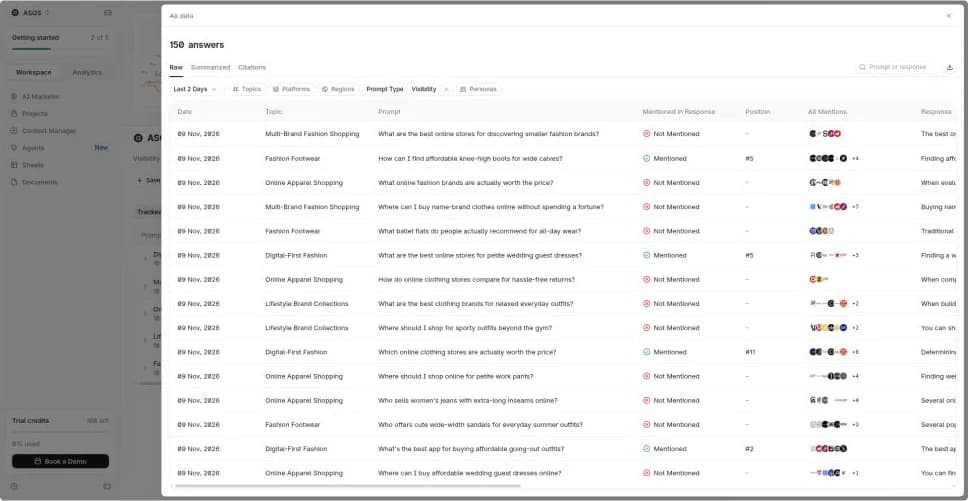
Profound's strength is evidence. In the trial every score opened onto the full answer behind it, and the data exported in bulk: 150 answers and 558 citations on the first day. A retailer can read what an assistant said about ASOS, and which brands it named beside it, before trusting a percentage.
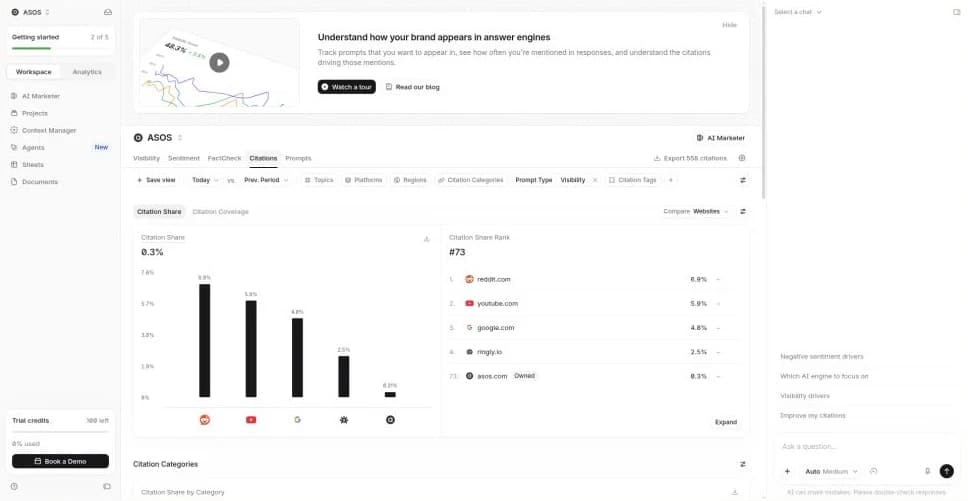
Its citation analytics show which websites the answers drew on. For ASOS that day, asos.com held 0.3% of citations and ranked 73rd, behind reddit.com, youtube.com and google.com, which tells a retailer where assistants read about its category.
The trial is generous: seven days and 50 prompts a day across ChatGPT, Gemini and Google AI Overviews, with no card asked for.
What should a UK retailer weigh?
Three points stood out for a UK retailer, each as found on the day.
- Market: the setup defaulted to the United States for ASOS, with a competitor set of Nordstrom, Uniqlo, Old Navy and Quince. The trial covers one region, and more are on Enterprise.
- Prompts: the trial ran a prompt set Profound chose, and its pricing page says trial prompts cannot be customised. One prompt in the answer table above asks where to shop for “petite work pants”, which a UK shopper would call trousers.
- Shopping: shopping and product analysis is on Enterprise, and after the trial the route to a paid plan is through Profound's sales team.
These are questions of setup and plan. Settle them before reading the first report as a picture of your own market.
Best suited to: teams that want deep answer and citation research, with every score traceable to its answer, and are ready to buy through sales.
Peec AI, Otterly.AI and Sighted compared as Profound alternatives
In the evaluation, Profound, Peec AI and Otterly.AI reported on visibility and none changed product information. That “what to change” check separates the three alternatives below.
Peec AI for product tracking from your catalogue
Peec AI tracks brand visibility, sentiment, position and citations, and adds product-level reporting. Its pricing page, read on 9 November 2026, lists tracking for each product (SKU-level) on every plan once you upload a catalogue from Shopify, a CSV or Merchant Center. Starter is $95 a month for 50 prompts.
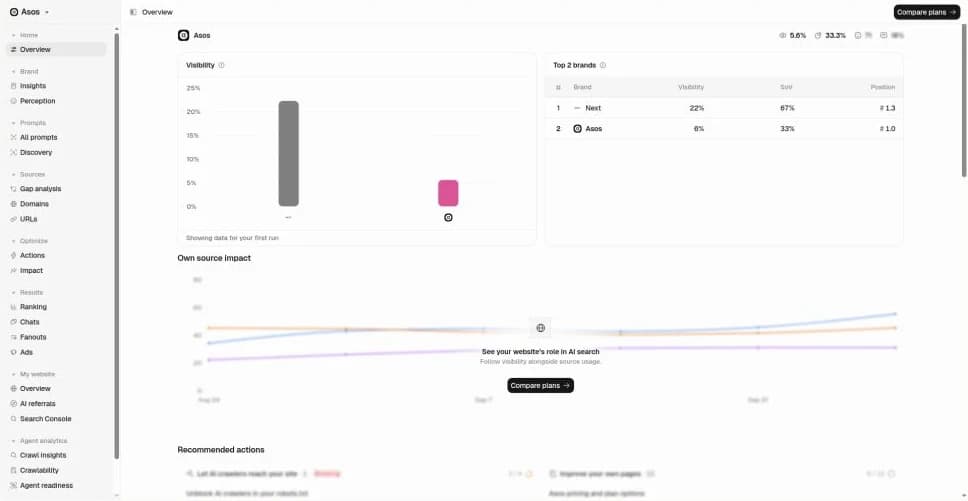
The evaluation used Peec's free preview, whose source and Gap Analysis views point to the pages and publishers that feature competitors. Full answers stayed behind the paywall and some tiles showed demo data, so judge the product reports on the trial, which runs seven days, takes a card and renews at $245 a month.
Two published hands-on reviews cover Peec on paid and live accounts: AEOToolsHub's Peec AI review and SaaSInsight's Peec AI analysis.
Best suited to: teams that want product-level tracking, competitor comparison and source-led planning at a published price.
Otterly.AI for brand and citation monitoring in your market
Otterly.AI got the market right without being told. Its trial detected the United Kingdom for ASOS and chose competitors a UK shopper would recognise, among them Next, New Look and River Island. Each prompt links to its answer and the URLs cited.
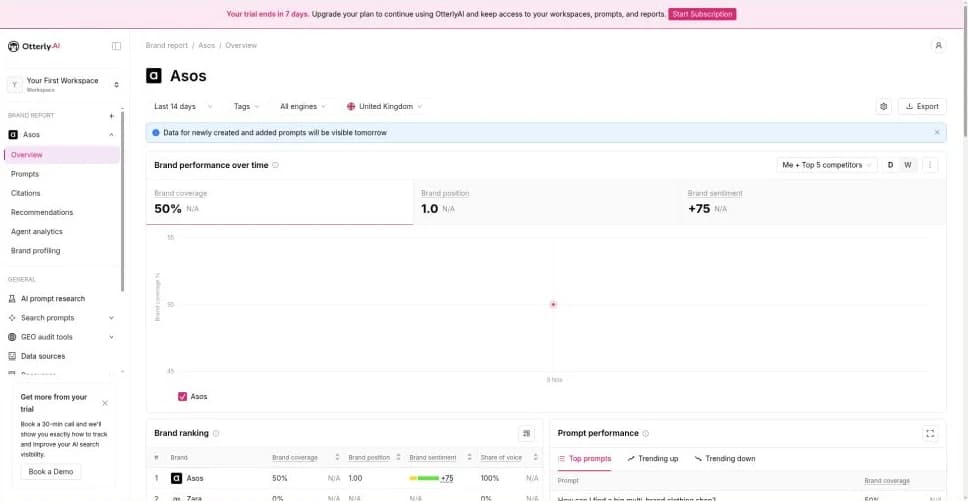
That first prompt returned 31 citations, none of them to asos.com. Reporting is at brand level, and the evaluation found no product or shopping tracking. Lite is $29 a month for 15 prompts, by its pricing page, and the seven-day trial asks for no card.
Best suited to: a small team that wants to start monitoring its brand, sentiment and citations in its own country at a low entry price.
Sighted for product visibility, catalogue changes and sales
Sighted analyses visibility product by product, finds the gaps in your catalogue, enriches product information, optimises feeds for AI agents and Google Shopping, publishes to Shopify and supported channels, and then measures the visibility, traffic and sales that follow.
The questions come first: suggested from your catalogue, then edited, added to, removed and approved by you.
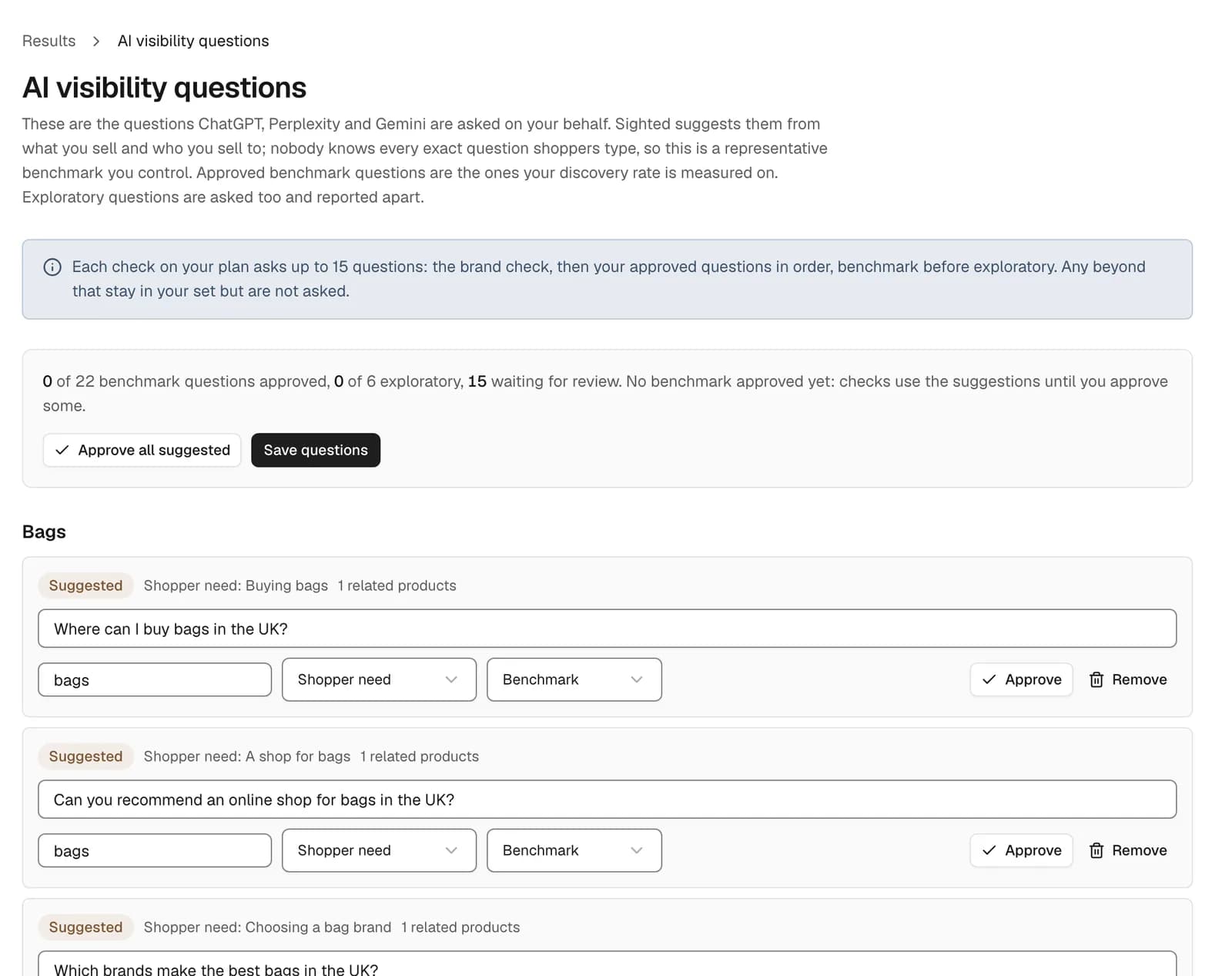
For a product, ChatGPT, Perplexity and Gemini are asked questions that name it and questions that describe the need without naming it. Each answer is recorded for whether it identified the product, recommended it, named your store and linked your site or the exact product page.
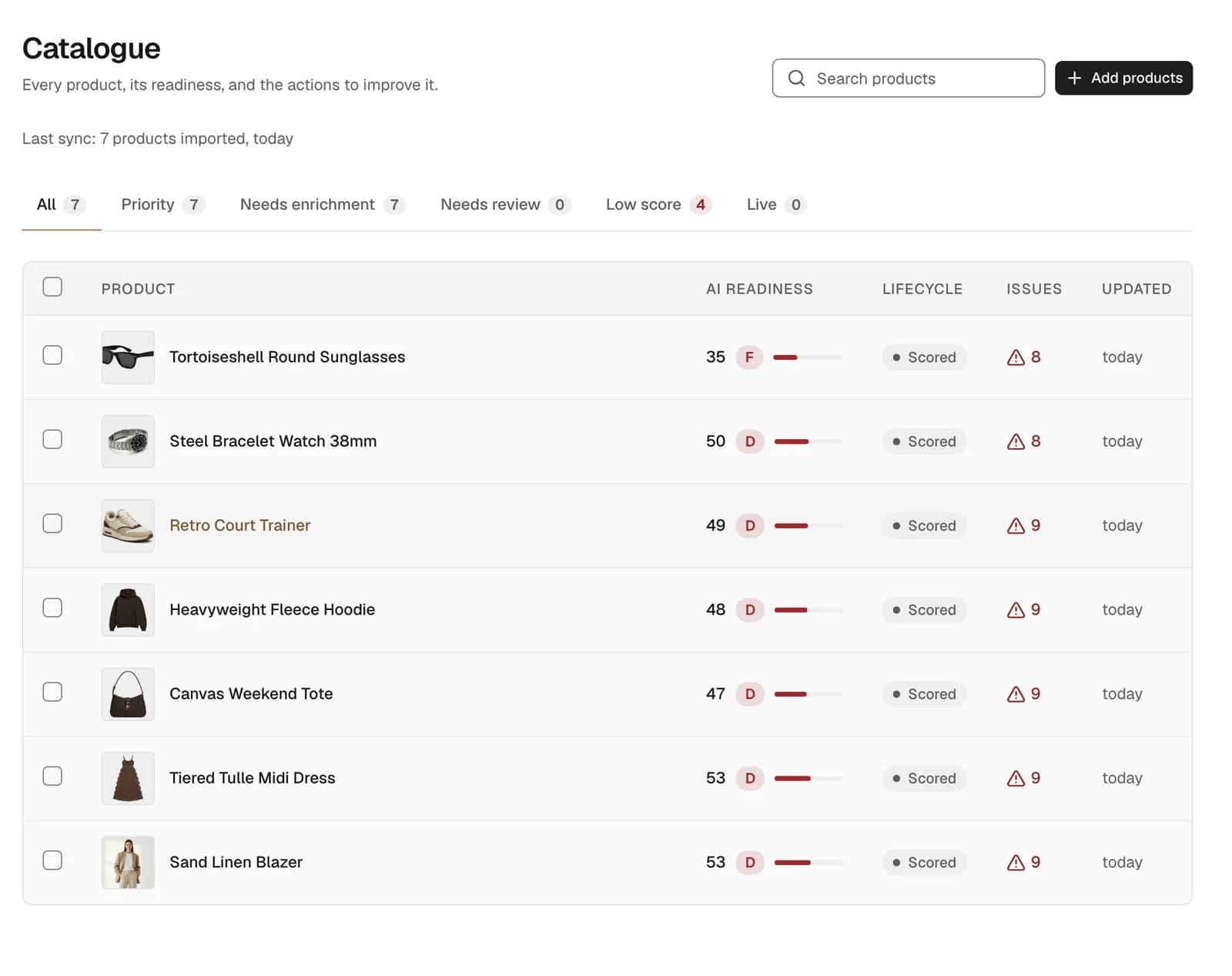
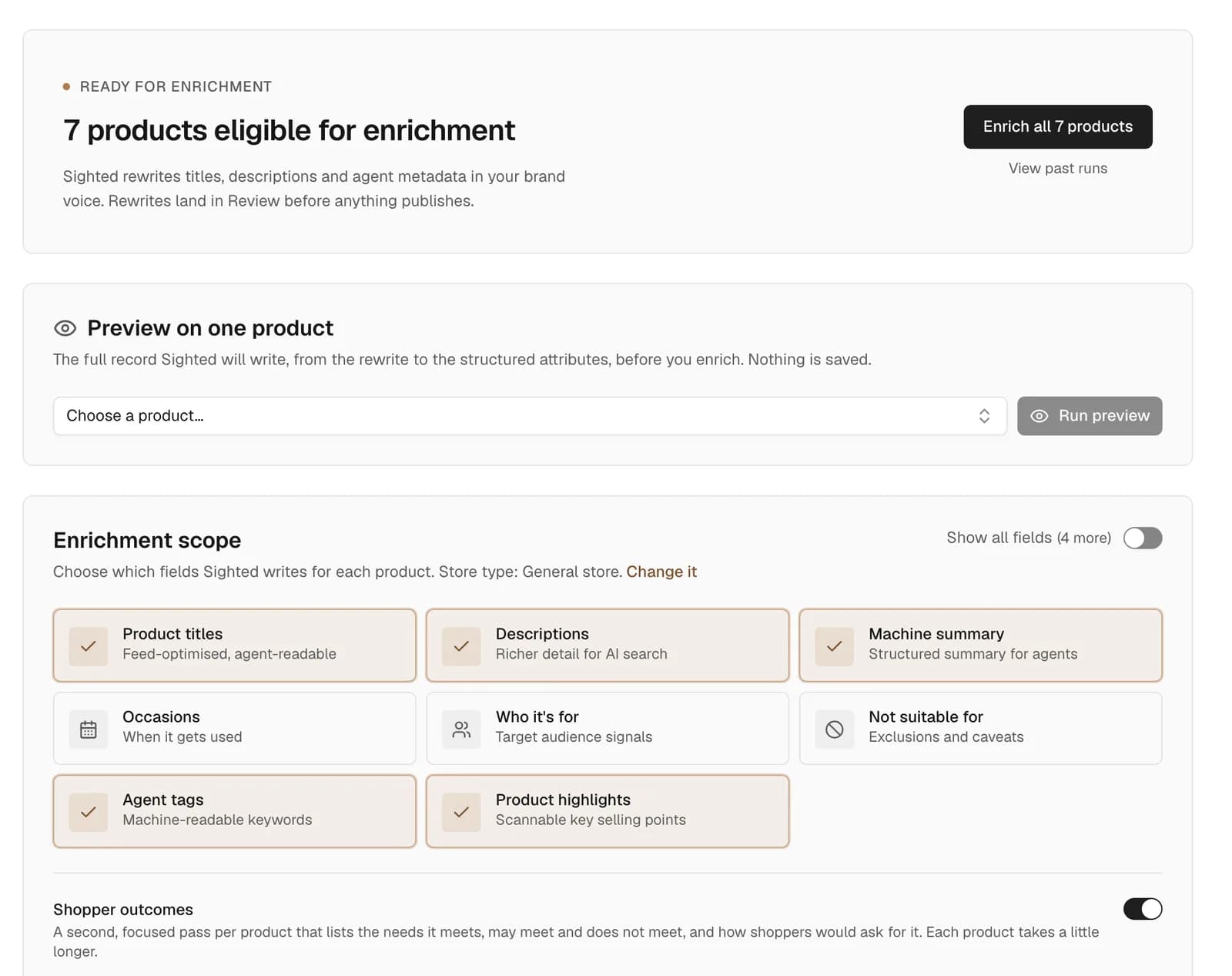
Every imported product also gets an AI readiness score, a grade and a count of its issues, which shows where the gaps are. Enrichment then writes the missing attributes, titles, descriptions and FAQs from your own product information.
By default every rewrite waits in Review, where you approve, edit or reject it, and a claim Sighted cannot verify from your information is held for you to check.
Approved changes are written to your Shopify store, and feeds for Google Shopping and AI agents are built from the same information. Sighted connects directly to Shopify; on another platform you upload a product file (CSV) and the approved information goes out through the feeds.
The Results page then sets the visibility checks beside sessions and purchases from Google Analytics, clicks from Search Console and, on Shopify, AI-referred orders and sales by product. You can see whether the products you changed are recommended, visited and bought more than before.
Best suited to: retailers who want to see how each product fares with AI assistants, improve the catalogue and feeds behind it, publish, and measure traffic and sales in one place.
What happens after you change the catalogue?
After a report, the commercial question is what happens to recommendations, visits and orders once the product information behind them improves. Ask every vendor how that second measurement is taken.
The Game Collection: citation coverage up from 0% to 32% of the priority products tested
At The Game Collection, 200 products were enriched and 17 collections created, and AI citation coverage went from 0% to 32% of the priority products tested. Its organic conversion rate rose 64%.
The enrichment and the collections were done together, so the result belongs to both. For a retailer choosing a tool, it shows what to ask for: a measurement on named priority products before the work, and the same measurement after it.
What do you change when a product is left out?
Read the answer for the details it gives about the product it chose. If it recommends another store's puffer jacket for its fill power and temperature rating, and your jacket's record states neither although you hold both figures, add them to the record. Publish, then ask the same question again.
How to evaluate a Profound alternative before committing
Give each shortlisted tool the same small job in the same week, on a range that matters to your trade.
- Pick ten products from one range: some own-brand, some that other stockists sell too. Note each product's page address, price and stock on the day.
- Write fifteen to twenty questions a shopper would ask. Mix ones that name a product (“Where can I buy adidas Samba OG trainers?”) with ones that describe a need (“waterproof walking boots for wide feet”).
- Set the same country and language in every tool. Note where a trial will not let you change the prompts, the region or the competitor list.
- Read the answers themselves. For each, note whether a product you stock was suggested, which stores were named and where every link leads.
- Ask what happens after a finding. Have the vendor show, on one of your ten products, what would change and who would do it.
- Price the plan that includes what you tested: product or shopping reports, your countries, enough prompts and the exports you used.
- Put visibility, visits and orders for those ten products into one review, and repeat it after every change you publish.
Profound alternatives for ecommerce FAQs
Is Profound a good choice for an online retailer?
Profound suits a team that wants deep answer and citation research and is happy to buy through sales. Check that the region, the prompts and the shopping analysis you need are on the plan you are quoted. The best AI visibility tools for ecommerce comparison covers Profound beside the same three tools.
How much do Profound alternatives cost?
As of November 2026, Otterly.AI's pricing page lists its Lite plan at $29 a month and Peec AI's lists Starter at $95 a month. Profound offers a seven-day trial and then sells through its sales team. Sighted is in early access and starts with a free scan of your store.
Which Profound alternative tracks individual products?
Peec AI's pricing page lists product-level tracking on every plan once a catalogue is uploaded. Sighted checks a product with questions that name it and questions that describe the need, and records whether each answer linked your store.
Which alternative suits a Shopify store?
Ask whether a tool reads your Shopify catalogue, writes approved changes back to it, or both. Peec AI's pricing page lists a Shopify catalogue upload for monitoring. Sighted connects to Shopify, publishes the changes you approve to the store and reads its orders to report AI-referred sales by product.
How to choose your Profound alternative
Start from the question your team has to answer this quarter. If it is where the brand stands in answers and which sources shape them, a monitoring tool does the job. If it is which products are recommended, who gets the link and what to change, choose a tool that works product by product and carries the change through to your store.
Sighted's free scan reads robots.txt and up to 50 of your product pages. It shows what assistants can reach and which product details are missing, which sizes the catalogue work before you buy anything.
Sources and author
What was tested: on 9 November 2026 Profound and Otterly.AI were each run on a free trial against asos.com, with a brief of ten products and eighteen shopper questions, and no paid plan was taken out.
Peec AI was seen through its free preview on the same day; its plans and trial terms are from its pricing page and activation email. Plan details for Profound and Otterly.AI are from their pricing pages, read that day. Plans and prices change. The two published Peec AI reviews are their authors' findings.
Screenshots: the Profound, Peec AI and Otterly.AI captures are from the ASOS evaluation. The Sighted captures show the platform with a sample store's data.
Customer result: The Game Collection pilot, as Sighted recorded it, with AI citation coverage going from 0% to 32% of the priority products tested.
The author, Molly Sishton, co-founded SO-ME and Sighted and has worked in SEO for more than ten years.
See which product details assistants cannot find on your pages before you compare tools.