

Best GEO tools for ecommerce in 2026
The best GEO tools for ecommerce help a retailer change what AI assistants say about the products it sells, then show whether recommendations, visits and sales moved. Generative engine optimisation (GEO) is the work of improving how your store and products appear in AI-generated answers. Compare tools by what each one changes: articles and FAQs, crawler access, mentions on other sites, or the product record itself.
By Molly Sishton. Updated .
In short
- Profound flags the topics where a brand is missing, and its AI Marketer agents draft blog posts, FAQs and campaign copy.
- Peec AI gives an action list of crawler, content and mention tasks, backed by source and gap analysis.
- Otterly.AI gives a to-do list prioritised by impact, with GEO audit tools and AI crawler analytics.
- Sighted checks visibility product by product, finds catalogue gaps, enriches product information, optimises feeds, publishes to Shopify and supported channels, and measures the visibility, traffic and sales that follow.
Best GEO tools for ecommerce at a glance
Match the tool to the change your store needs. A retailer whose buying guides go uncited needs different help from one whose product records leave out the details shoppers ask for, such as the fabric of a dress or the fit of a boot.
| Tool | Best suited to | What it changes |
|---|---|---|
| Profound | Finding topic gaps and drafting articles, FAQs and campaign copy | Marketing content, drafted by its AI Marketer agents for the topic gaps it flags |
| Peec AI | Planning content, outreach and crawler fixes from source and gap analysis | Your team's task list: crawler, content and mention tasks |
| Otterly.AI | A to-do list ranked by impact, with page audits and crawler analytics | Your team's to-do list: actions ranked by impact, with page audits and AI crawler traffic reports |
| Sighted | Product-by-product visibility analysis, product information enriched from your own data, feeds, publishing, and visibility, traffic and sales measurement | The product record and feeds: enriched from your own data, approved by you, published to Shopify and supported channels |
What building SO-ME taught Sighted's founders about product information
Molly and Connie Sishton, sisters, co-founded SO-ME, a consumer shopping platform bringing together products from retailers including ASOS, Marks & Spencer and REVOLVE.
Working with retailer catalogues exposed a recurring problem. Shoppers describe occasions, preferences and constraints, while product records use inconsistent categories and leave out useful attributes.
Take a dress for a winter wedding. Size, budget, length, fabric and delivery can all affect the buying decision. A dress can fit the brief and still be hard to match when those details are missing from its record.
They built Sighted to address that gap. This comparison follows from it, and asks of each tool what it changes in the content around a product and in the product information itself.
What should a GEO tool change for an online store?
An assistant puts a shopping answer together from several places. The table sets out each one, the change open to you and the question to put to a vendor.
| What an assistant draws on | What you can change | Ask of any tool |
|---|---|---|
| Guides, FAQs and category pages on your site | Publish the page that answers the question, such as a guide to winter-wedding outfits linking the dresses you sell | Does it draft the page, and who edits and publishes it? |
| Other sites it cites: publishers, forums, video | Earn a mention where the assistant already looks, such as a boot round-up that lists other stockists | Does it show the cited pages, question by question? |
| Your own pages, when its crawler can reach them | Allow the search crawlers you want in robots.txt, such as OAI-SearchBot | Does it test access on your own product pages? |
| The product record: title, description, attributes, FAQs | State the details shoppers ask for, such as wide fit, heel height or lining | Does it change the record, from what information, and who approves? |
| Feeds sent to shopping systems | Send the approved details to Google Shopping and AI agents | Where does the changed product information go? |
Why does the product record count as GEO?
For a retailer, the product record is one of the things an assistant reads. OpenAI's shopping help says, as of November 2026, that ChatGPT considers structured metadata such as price and product description when it decides which products to show.
Take a shopper who asks for black wide-fit ankle boots under £80. A buying guide can earn your site a citation. If the boot's own record never says “wide fit”, the assistant has nothing in that record to match to the request.
What the ASOS evaluation showed about acting on GEO findings
Profound, Peec AI and Otterly.AI were each pointed at asos.com on 9 November 2026, with the same ten products and eighteen shopper questions. Profound and Otterly.AI were tested first-hand on free trials; Peec AI through its free preview and its pricing page. Four buying checks came out of it.
1. Does the finding point to something you can change?
Profound's citation view showed asos.com supplying 0.3% of the citations in answers about ASOS, ranked 73rd, behind Reddit, YouTube and Google. Those answers were built from other sites, which makes content and mentions the place to act.
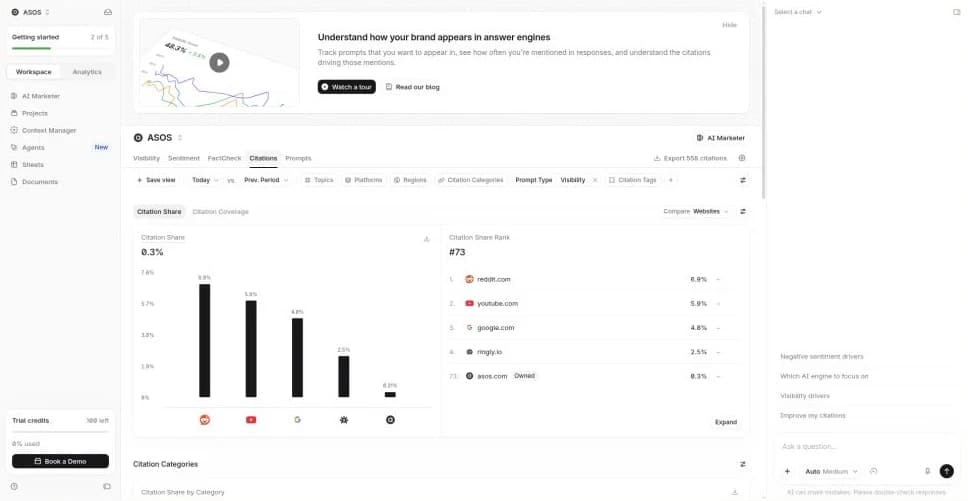
Profound also split visibility by topic. ASOS scored 68.9% on digital-first fashion and 6.7% on fashion footwear, so footwear is where a content team would start, and Profound's AI Marketer agents can research and draft that content.
2. Can you read the answers behind the advice?
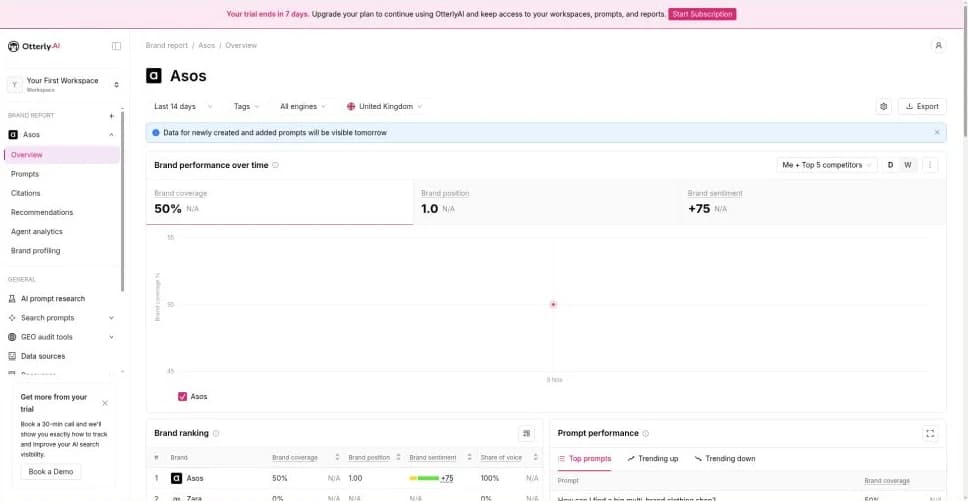
Every Profound score opened onto the full answer, and Otterly.AI linked each prompt to its answers and the pages they cited. Read them before acting. Otterly.AI's first ASOS report showed 50% brand coverage in first position, while the 31 citations behind those answers were third-party blogs and none was a page on asos.com.
3. Is the advice about your store and your market?
Otterly.AI detected that ASOS is a UK retailer and chose UK competitors, among them Next, New Look and River Island. Profound's setup defaulted to the US, with Nordstrom, Uniqlo, Old Navy and Quince.
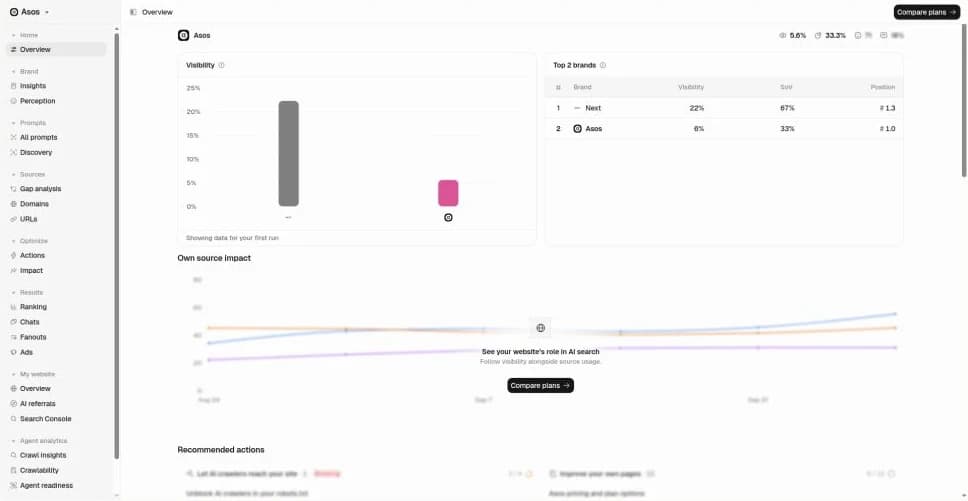
On Peec AI's free preview the overview held ASOS's own figures, while the recommended-actions panel was filled with sample data. Ask to see the action list for your own store before you judge it.
4. Who changes the product information?
All three tools monitor and report. In the evaluation none of them changed the product catalogue: none wrote a better title, attribute or description into a product record or a feed. Peec AI's pricing page says it takes in a catalogue from Shopify, a product file or Google Merchant Center, to track visibility product by product.
If the gap is in the record itself, say an ankle boot listed without its width or heel height, decide who will make that change and where it will be published.
Profound vs Peec AI vs Otterly.AI vs Sighted
Profound for topic gaps and drafted marketing content
Profound's seven-day trial runs a prompt set each day across ChatGPT, Gemini and Google AI Overviews and scores visibility by topic and by competitor. Its citation analytics show which domains and pages the answers are built from.
Its AI Marketer agents, which run on credits, research and draft marketing content: blog posts, FAQs and campaign copy. A fashion retailer weak on footwear questions could have a boot-care guide drafted, then edit and publish it.
Best suited to: marketing and content teams that want gaps found by topic and first drafts of articles, FAQs and campaign copy.
Peec AI for source-led content and outreach planning
Peec AI's free preview built a brand profile and a prompt set labelled by intent and persona, then tracked how often asos.com was used as a source. Its sources and gap analysis views show which domains shape the answers.
Its action list groups the work into crawler, content and mention tasks. A cookware retailer might find that answers about non-stick frying pans lean on two review sites, and treat a product review on each as a mention task. Peec AI's pricing page says every plan tracks visibility product by product from an uploaded catalogue.
Best suited to: teams that plan content, outreach and crawler fixes from the sources assistants cite.
Otterly.AI for a prioritised to-do list and page audits
Otterly.AI was the fastest of the three to set up. Its recommendations section orders actions by impact, its GEO audit tools check how a page reads to an AI system, and its agent analytics report AI crawler traffic.
Custom prompts were accepted on the trial, so a homeware store could enter its own questions about linen bedding and audit the category page those questions should lead to. Otterly.AI's pricing page lists its Lite plan at $29 a month for 15 prompts.
Best suited to: smaller teams that want a to-do list ranked by impact, with page audits, at a low starting price.
Sighted for product visibility, product information, feeds and measurement
Sighted analyses visibility product by product, identifies catalogue gaps, enriches product information from your own data, optimises feeds for AI agents and Google Shopping, publishes to Shopify and supported channels, and measures the visibility, traffic and sales that follow.
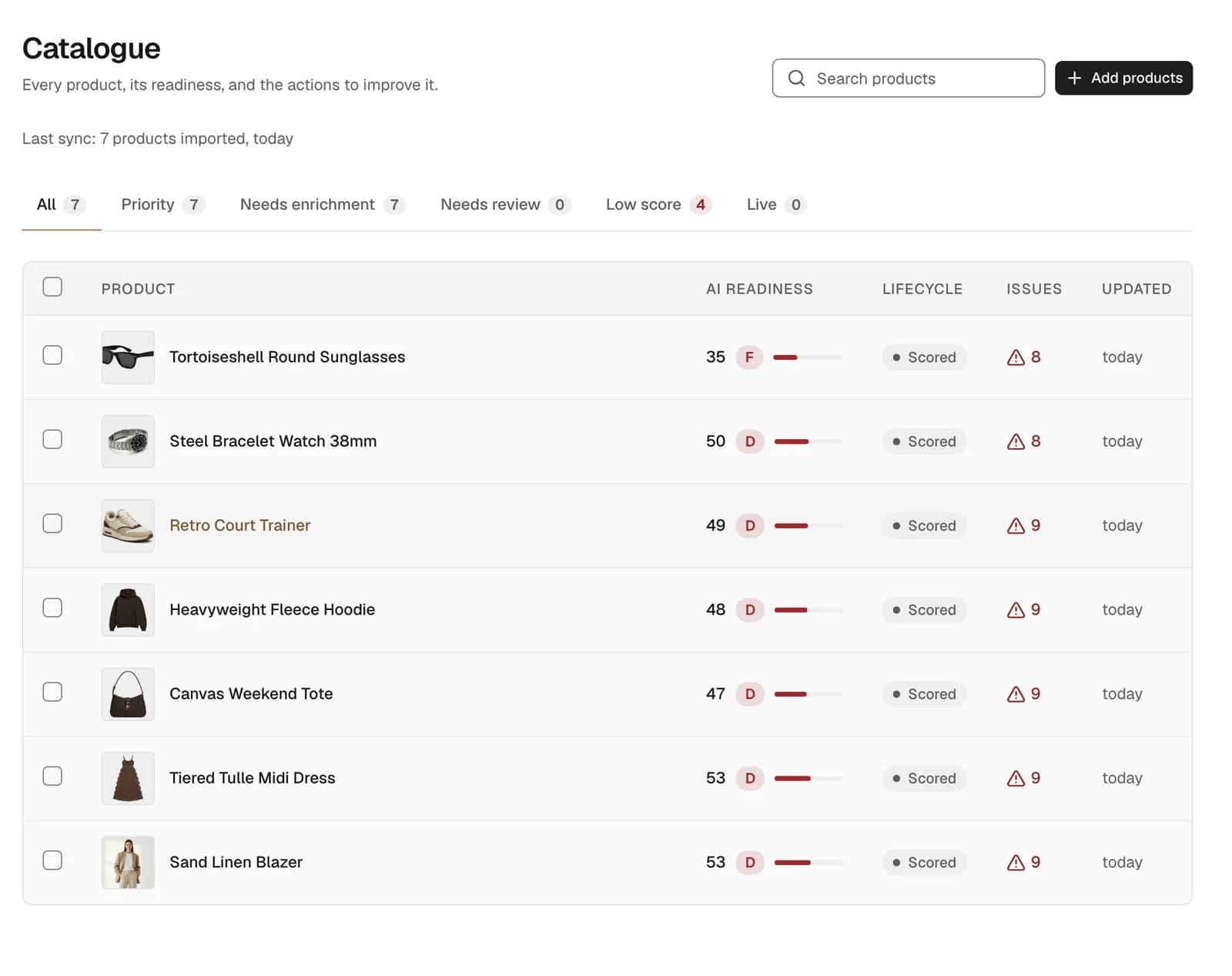
Start with the gaps. Every imported product is scored and graded with its issues counted, which shows where records are missing attributes and information. For clothing, look first at fabric and fit.
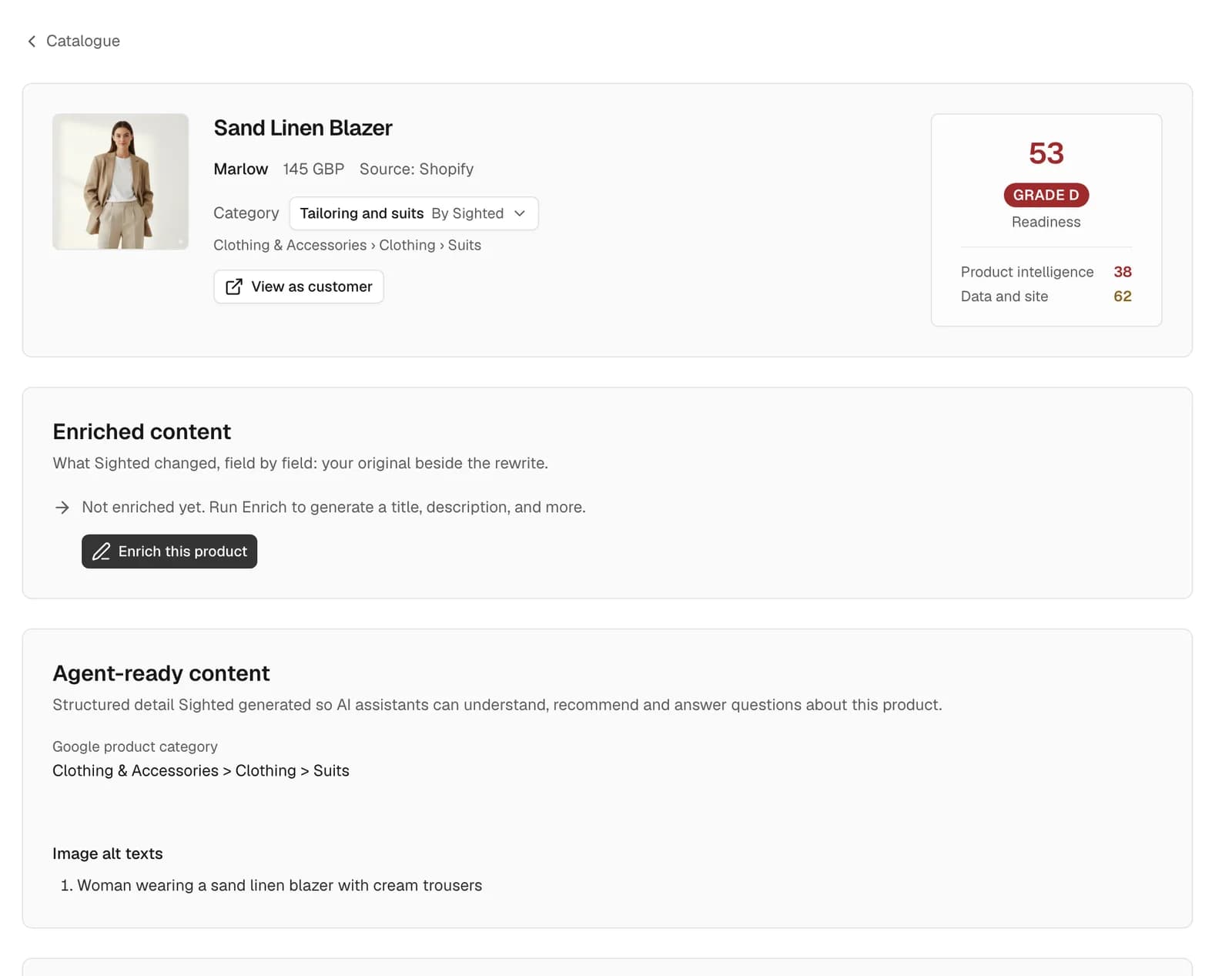
Enrichment writes attributes, titles, descriptions and FAQs from your own product information. By default each rewrite waits in Review for your approval before anything is published.
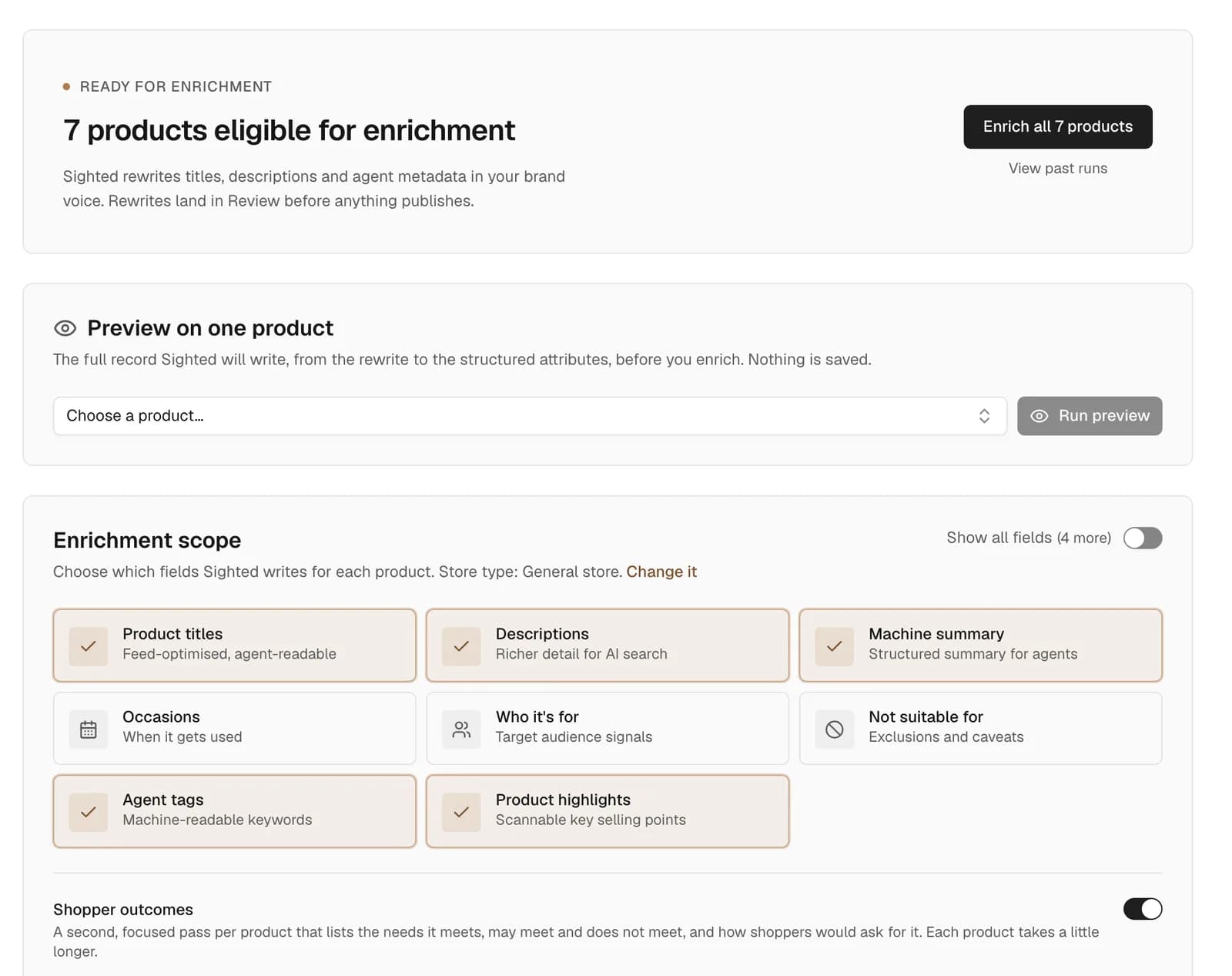
Approved information is published to your Shopify store and carried into feeds for Google Shopping and AI agents, so an approved detail such as the blazer's linen fabric reaches the places shopping systems read.
Then measure. Sighted asks ChatGPT, Perplexity and Gemini questions that name the product and questions that describe the need. It records whether each answer identified the product, recommended it, named your store and linked the right page, and reports those answers beside traffic and sales.
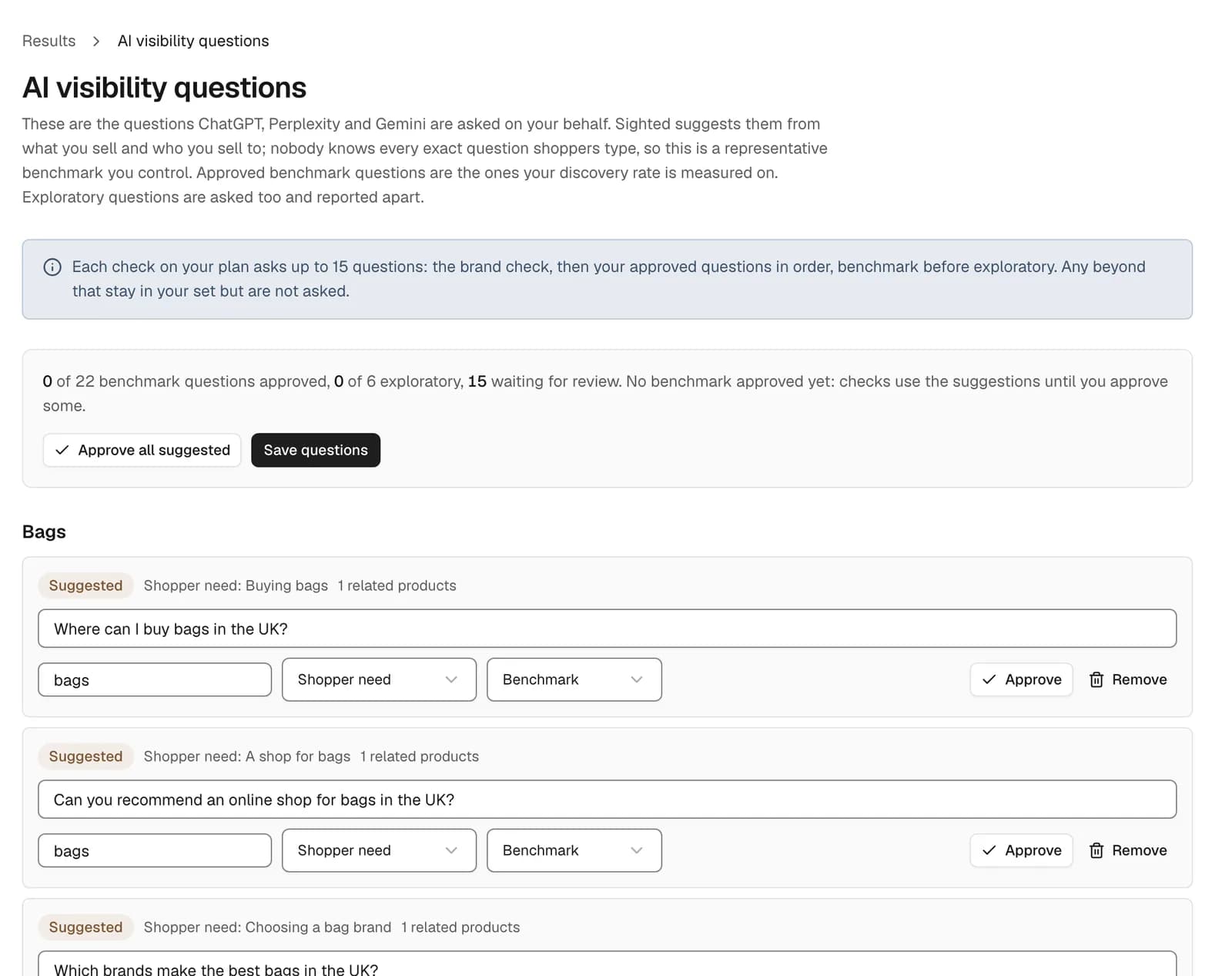
Best suited to: retailers who want visibility analysed product by product, the product information itself improved from their own data, published to the store and feeds, and measured in visibility, traffic and sales.
How do you know a GEO change worked?
Judge a change by what happened after it was published. Ask the same shopper questions before and after, product by product, then look at visits and sales for the products you changed. For the wide-fit boot, that means asking for black wide-fit ankle boots under £80 again and checking whether the boot is named and your store linked. The guide to measuring AI shopping performance covers the analytics.
ChristianShirts.Net: AI citation coverage 0% to 27%
In Sighted's pilot with ChristianShirts.Net, the work was structured content and schema improvements, schema being the markup that states a product's details in a form software can read. AI citation coverage went from 0% to 27%.
For a retailer choosing a GEO tool, it shows the measure to ask for: whether assistants cite the store once the information they read has changed.
How to evaluate a GEO tool before committing
Run the test on one range you care about, such as winter coats or coffee machines, so the result is a decision about real products.
- Pick ten products in that range: best sellers, a new line and one that assistants pass over. Note what each record states today.
- Write down the questions shoppers ask about the range, taken from site search and customer emails. Have some name a product and some describe a need.
- Ask each tool for its recommendations on that range. Sort every one by what it changes: a page, crawler access, a mention on another site or the product record.
- Put a name and a time against each recommendation, so you can see which ones your team can carry out.
- Check what the tool changes itself, where that change is published and who approves it first.
- Make one change to half the products and leave the rest as they are. After it is published, ask the same questions again.
- Review visits and sales for the changed products beside the answers, with price, stock and promotions in view.
GEO tools for ecommerce FAQs
Do GEO tools make the changes for you?
In the ASOS evaluation, Profound's agents draft marketing content and Otterly.AI lists tasks for your team; Peec AI's preview and pricing page describe an action list. None of the three changed product information. Sighted enriches product information from your own data and publishes what you approve to your Shopify store and to feeds for AI agents and Google Shopping.
Which GEO tool suits a Shopify store?
Ask what the tool does with the connection. Peec AI's pricing page says it reads a Shopify catalogue to track products. Sighted connects directly to Shopify, enriches product information, publishes approved changes to the store and its feeds, and measures the visibility, traffic and sales that follow. For a store on another platform, you upload a product file (CSV).
How much do GEO tools cost?
On 9 November 2026 the vendors' pricing pages listed Otterly.AI Lite at $29 a month for 15 prompts and Peec AI Starter at $95 a month for 50 prompts. Profound offered a seven-day trial, with paid plans sold through its sales team. Add the cost of the people who write, approve and publish the changes a tool recommends.
How to choose your GEO tool
Start from what assistants are missing. If answers in your category cite guides and review sites, choose a tool that plans content and mentions. If your product records leave out details shoppers ask for, choose one that changes the records and shows what followed in visibility, traffic and sales.
Run Sighted's free scan first: it reads robots.txt and up to 50 of your product pages, then reports what assistants can reach and which product details those pages lack. If your first question is what to monitor, the comparison of AI visibility tools covers the same four tools from that side.
Sources and author
First-hand testing: Profound and Otterly.AI were run on free trials against asos.com on 9 November 2026, with ten products and eighteen shopper questions. Peec AI was assessed from its free preview. No paid plan was started.
Vendor and platform information: plan, price and catalogue-upload details come from the Profound, Peec AI and Otterly.AI pricing pages, and the ChatGPT details from OpenAI's shopping help and crawler documentation, all read on 9 November 2026. Features and prices can change.
Published hands-on reviews of Peec AI: AEOToolsHub's paid-account review and SaaSInsight's live-account analysis. Their findings are those authors' own.
Screenshots: the Profound, Peec AI and Otterly.AI images are from the ASOS evaluation. The Sighted images are platform screenshots showing a sample store's data.
Customer result: Sighted's pilot with ChristianShirts.Net, in which AI citation coverage went from 0% to 27%.
About the author: Molly Sishton co-founded SO-ME and Sighted with her sister Connie, and has worked in SEO for more than ten years.
See what assistants can reach on your store and which product details are missing.